If a part took longer to arrive this year, or a quote came in higher than you expected, the reason usually starts upstream. The auto parts supply chain in 2026 is in the middle of its biggest re-wiring in a generation, driven by 25% tariffs, a scramble to diversify away from China, and a wave of “nearshoring” that is pulling production toward Mexico and the U.S. This is the sourcing side of the story. If you mainly want to know how it hits your wallet and how to save, our companion guide on why auto parts prices are rising in 2026 is the how-to-save read. Here, we explain the machinery behind the shift.
- The auto parts supply chain is being reshaped by two forces at once: 25% Section 232 tariffs that took effect in 2025, and a fast-moving push to move sourcing closer to home (“nearshoring”), largely to Mexico.
- The near-term side effect is friction, longer lead times, uneven stock, and higher landed costs, because suppliers are re-routing supply chains all at once.
- For a car owner it means availability and price now depend heavily on where a part is made. Parts built under North American content rules are the most stable; deep-China-sourced items are the most exposed.
01 · Tariffs turned sourcing into a strategy problem
The catalyst was trade policy. Under Section 232, a national-security provision of U.S. trade law, a 25% tariff on imported vehicles and a broad list of auto parts took effect in 2025, and it was not limited to new-car assembly. Aftermarket, repair, and maintenance parts were swept in too. In April 2026 the related metals tariffs were restructured to apply to a wider set of steel, aluminum, and copper “derivative” products, broadening the duty exposure again.
A tariff of that size doesn't just raise a price, it changes the math on where a company chooses to build. Overnight, a supply chain optimized for the lowest unit cost in Asia became a supply chain carrying a 25% penalty at the U.S. border. That single change is why sourcing, not just pricing, became the industry's central question in 2026.
Parts that comply with the U.S.-Mexico-Canada Agreement (USMCA) are largely exempt from the 25% parts tariff. That's the pivot the whole industry is turning on: a component built to North American content rules can dodge the duty, while the same part sourced from Asia carries it in full. Where a part is made now directly shapes its price and its availability.
02 · Nearshoring: why Mexico is the center of gravity
“Nearshoring” means moving production closer to the market it serves, for the U.S., that overwhelmingly means Mexico. It combines lower labor costs than the U.S., duty-free access under USMCA, and a border that trucks can cross in a day instead of a container ship taking weeks. Major automakers including GM, Hyundai, and Stellantis have all signaled reshoring or nearshoring moves, and the parts suppliers that feed them are following.
The scale of the ambition is real. Mexico's national auto-parts industry body has estimated the sector could capture up to roughly 40% of future nearshoring projects in the next wave, up from about 37% in the first wave, with much of that momentum expected to build from 2027 onward. Notably, the next phase is expected to compete less on cheap labor and more on technology, trade compliance, and deep regional integration.
For a buyer, this is mostly good news over time: a shorter, more regional supply chain is generally a more resilient and more predictable one. The catch is the transition itself.
03 · Why availability got bumpy in the meantime
Re-routing a global supply chain is not a switch you flip. When most of the industry pivots sourcing at the same time, long-standing production lines, routes, and supplier relationships all move together, and that churn creates temporary shortages and uneven inventory. Diversifying suppliers to dodge tariffs also, paradoxically, tends to lengthen lead times and squeeze margins while new relationships mature.
A few specific pressure points are worth knowing:
| Pressure point | What's happening in 2026 | Effect on you |
|---|---|---|
| Semiconductors | Lead times spiked early in the year, with top components reported near 40 weeks | Sensor- and electronics-heavy parts can back-order |
| Rare-earth materials | China export controls remain unresolved into 2026 to 2027 | Motors, magnets, and some EV parts stay tight |
| Supplier switching | New sources ramping to avoid tariffs | Temporary gaps, then steadier supply |
| Shop-level stock | Availability cited as a top operational challenge by many repair shops | “Right part, on time, in the right box” isn't guaranteed |
Directional, as of 2026. Conditions vary by part category, brand, and sourcing; treat this as a general map, not a guarantee for any one item.
Industry surveys through late 2025 and into 2026 put supply-chain disruption, parts shortages, and inventory management among the top challenges facing repair shops, one survey had roughly 45% of respondents naming it. The everyday version of that statistic is simple: the part you need is more likely than a few years ago to be on back-order or to arrive slower.

04 · Demand isn't shrinking, cars are getting older
All of this is landing on top of a market that needs more parts, not fewer. The average vehicle on U.S. roads hit a record 12.8 years old in 2025 and is expected to reach about 13 years in 2026, with passenger cars averaging around 14.5 years. Older cars need more repairs, so demand for replacement parts keeps rising even as the supply chain behind them is being rebuilt. A tighter supply meeting steady-to-rising demand is exactly the recipe for the availability wobbles and firmer prices owners have felt.
You don't control tariffs or nearshoring, but you do control timing. When you know a repair is coming (brakes, a converter, a suspension part), sourcing the part earlier, and favoring North American-made equivalents, is now a genuine hedge against both price creep and back-orders.
05 · How a smart buyer navigates a re-wiring supply chain
Buy ahead of known repairs
If a wear item is close, pads near their limit, a converter throwing codes, sourcing it now beats waiting for a restock that may be slower or repriced. Availability, not just price, is the thing you're buying.
Favor USMCA / North American-made parts
Because they're largely tariff-exempt, North American-sourced equivalents are often both more available and better value after duties. It's the single most reliable way to sidestep the exposed part of the supply chain.
Check real stock before you commit to a shop date
For electronics- and sensor-heavy parts especially, confirm the item is actually in stock, not just listed, before you book the labor. It saves the “car's on the lift, part's on back-order” trap.
Don't over-buy on rumor
Panic-stockpiling parts you may never fit ties up cash and warps your own little supply chain. Buy what a planned repair needs, keep a sensible margin of lead time, and skip the hoarding.
For the money-side companion to all this, which parts moved most and the concrete ways to keep a repair bill down, see our guide to auto parts prices and tariffs in 2026.
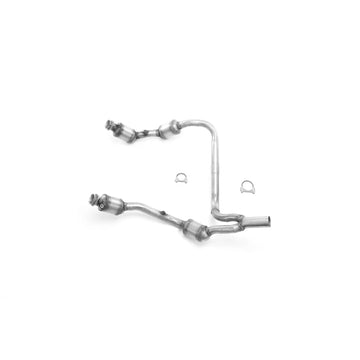
Catalytic converters carry precious-metal and import exposure, check in-stock, verified-fit options now. Shop catalytic converters ›.
Pads, rotors, and calipers in stock, source ahead of your shop date, not after. Shop brakes ›.
Trade-policy, tariff, and supply-chain details are directional and current as of 2026; policy and sourcing conditions can change quickly, and the impact on any specific part depends on its classification, brand, and country of origin. Figures cited are industry estimates and ranges, not quotes. Always confirm a part's emissions and safety compliance and its fitment for your exact year, make, model, and trim before purchase.